


Why a hex grid
Hexagons tile without gaps and give every cell six neighbours. That makes them useful for maps where movement happens in six directions, for honeycomb patterns, and for ring diagrams in chemistry.
Flat-top or pointy-top
Flat-top hexes form columns; pointy-top hexes form rows. The choice changes how a map reads and how coordinates are counted. Pick one orientation and keep it consistent across the whole project.
Choosing a size
| Hex side | Across flats | Use |
|---|---|---|
| 1/4 inch | ≈ 0.43 inch | Detailed patterns, chemistry |
| 1/2 inch | ≈ 0.87 inch | Tabletop maps, classroom games |
| 1 inch | ≈ 1.73 inch | Large maps, posters |
Printing tips
Print at Actual size so the hexes match miniatures and map templates. Use light gray lines to keep pencil marks readable, and pair with triangle paper for geometric patterns. The hexagon generator supports Letter, A4 and custom sizes.
In practice
A game master needs a hex map for 28 mm miniatures. One-inch hexes fit the bases and leave room for terrain; 1/2 inch hexes fit more map on the table but crowd the figures. Printing a test tile with one miniature is faster than printing the whole map twice.
Common mistakes
| Problem | Usually because | What to do |
|---|---|---|
| Miniatures do not fit | Hexes are too small | Use 1 inch across the flats |
| Rows and columns are confusing | Flat-top and pointy-top are mixed | Pick one orientation for the whole map |
| The map is the wrong scale | The PDF was scaled to fit | Print at Actual size |
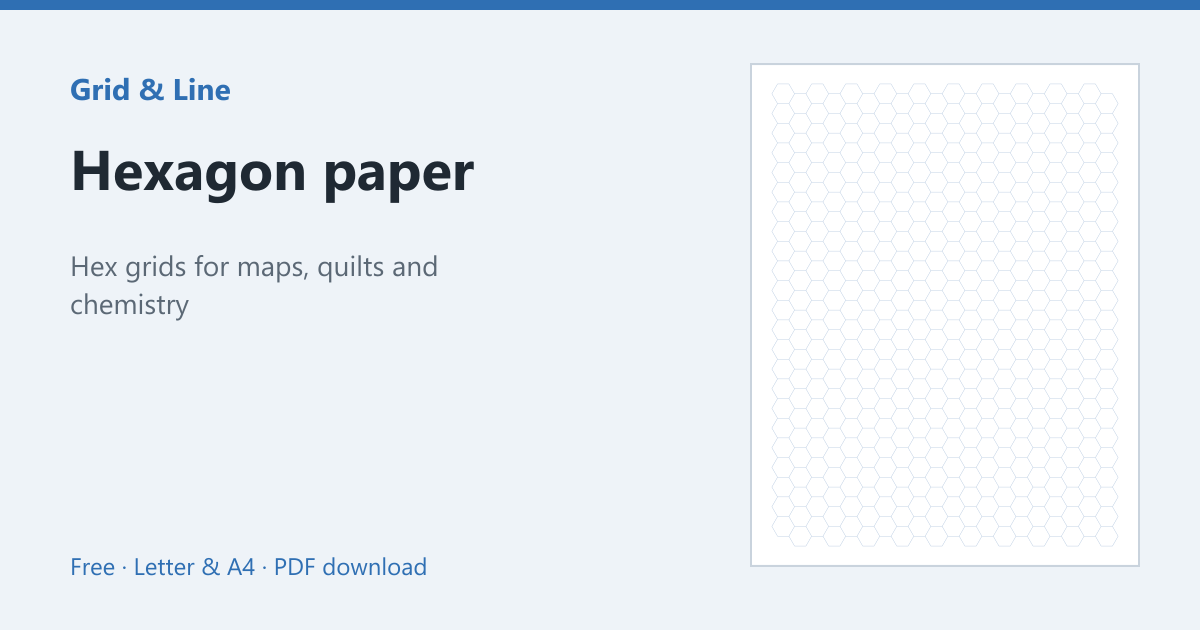 Hexagon paper
 Triangle graph paper
 Isometric paper