


Learn the strokes first
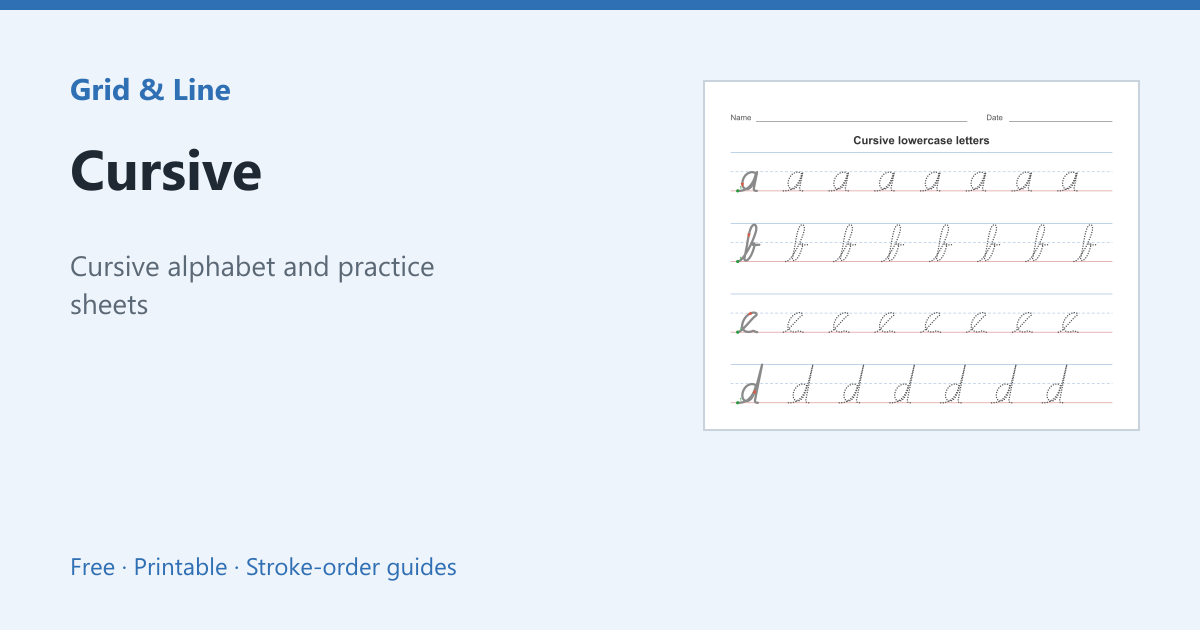
Cursive letters are built from a few repeating strokes: the undercurve, the overcurve, the loop and the retrace. Practise those shapes on their own before adding letters. The cursive practice sheets show each letter’s strokes in order, so you can see where the pencil starts and which way it travels.
Start with lowercase
Lowercase letters carry almost all the joins. Begin with letters that end on the baseline, such as a, c, d, o and q, then add letters with a high exit such as b, o, v and w. Each letter page on this site includes a stroke-order animation and a worksheet.
Joining letters
A join is simply the exit stroke of one letter continuing into the entry stroke of the next. Keep the join on the baseline and at a consistent height. If a letter ends above the baseline, add a short connector before the next letter. Practise pairs such as an, ee, ow and th before whole words.
Capitals and common mistakes
Add capital letters after the lowercase alphabet is secure. Common problems are a loop that is too large, a join that starts too high, and pressing too hard. Write slowly enough to keep the joins smooth, then increase speed only when the shapes stay consistent.
Print practice sheets
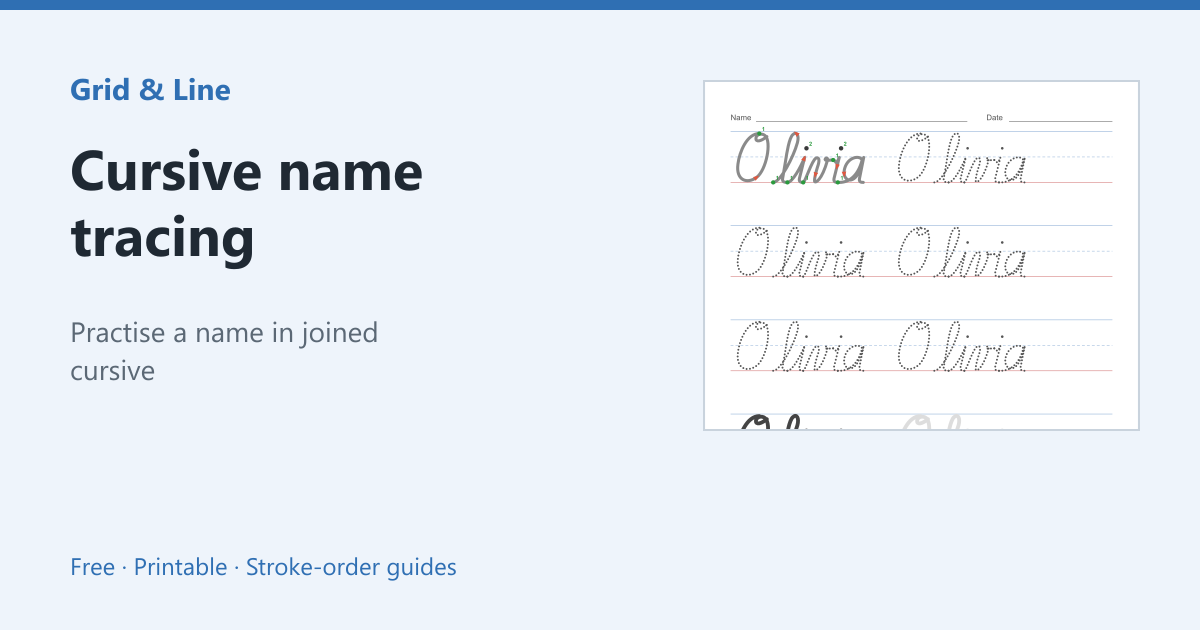
The cursive hub links every lowercase and capital letter, and cursive name tracing turns a name into a joined practice page. Print at Actual size so the line height matches the worksheet.
In practice
An adult who learned print wants to sign a card in cursive. Starting with the exit strokes and two-letter joins is faster than copying the whole alphabet, because most cursive problems are join problems, not letter-shape problems.
Common mistakes
| Problem | Usually because | What to do |
|---|---|---|
| Letters will not connect | The exit stroke stops above the baseline | Finish each letter on the baseline |
| The writing slopes differently | The paper is turned between letters | Keep the paper angle constant |
| Speed ruins the joins | Speed increased too early | Stay slow until joins are consistent |
 Cursive
 Cursive name tracing
 Staff paper