


Start with 0–9
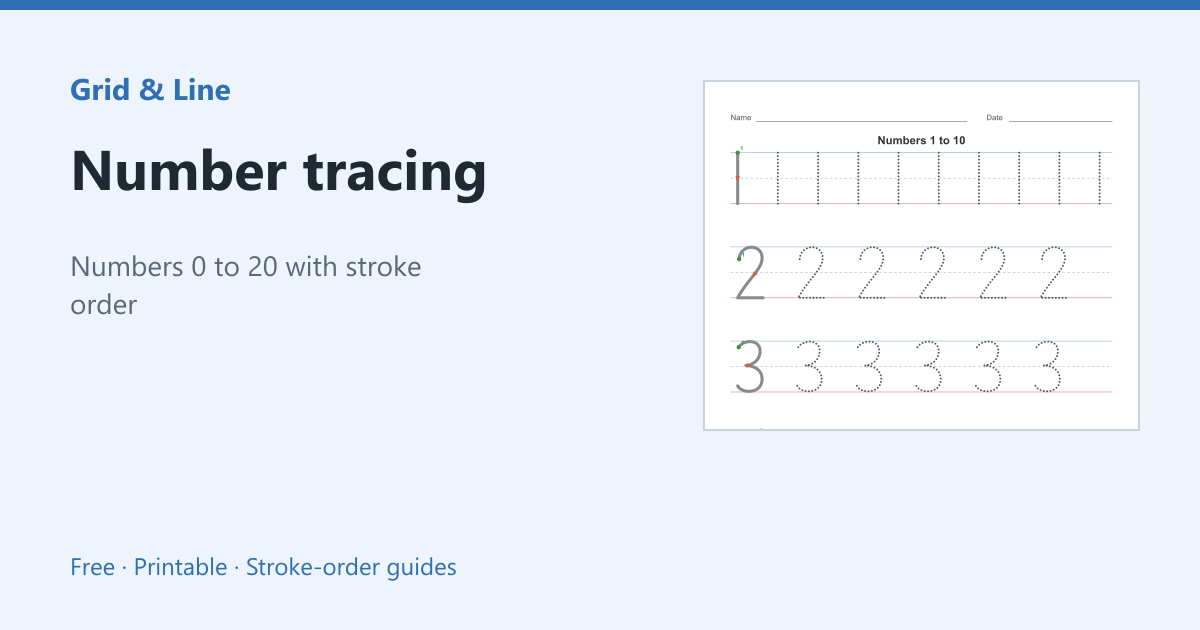
Each digit is a short sequence of strokes. Teach one digit at a time, always starting at the same point. A green start dot and a numbered stroke order make the movement explicit, which is especially helpful for 5, 6, 8 and 9.
Building 10–20
Once 0–9 are secure, show that 10 is a 1 and a 0, 11 is two 1s, and so on. Keep the digits close together and the spacing even. Writing the teen numbers as two separate digits avoids the common “101” mistake.
Fixing reversals
Reversals are normal in early years. Compare the child’s digit with a correct model, point to the starting point, and practise the digit in isolation for a minute. Do not erase and rewrite the same digit many times in one sitting.
Print number practice
The number tracing generator prints 0–20 with dotted models and blank rows, and lets you choose the range and letter size. Pair it with handwriting paper for free writing.
In practice
A kindergartener writes 13 as 103. The child is writing each digit separately but adding an extra zero. Modelling 10–20 as a tens digit and a ones digit, with the digits close together, fixes the concept and the handwriting at the same time.
Common mistakes
| Problem | Usually because | What to do |
|---|---|---|
| 6 and 9 are reversed | The starting point is not fixed | Trace from the dot and compare models |
| Teen numbers get an extra zero | The tens/ones structure is unclear | Build the number with blocks first |
| Digits drift apart | No spacing guide | Use a two-digit box or grid |
 Number tracing
 Handwriting paper
 Name tracing