


Axes and origin
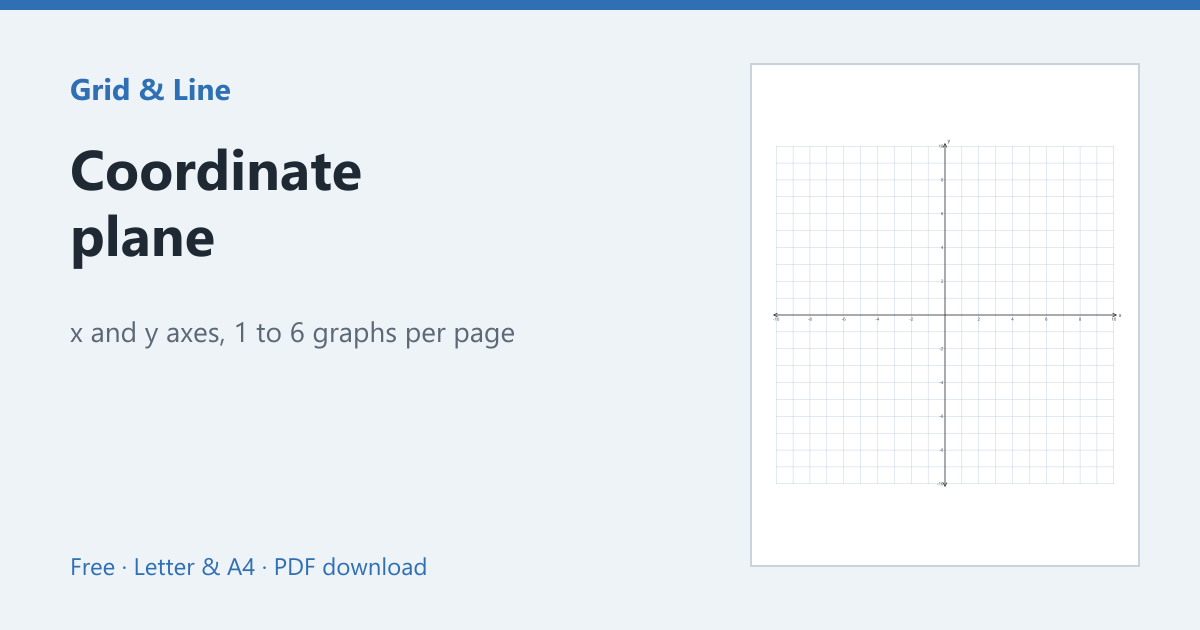
The horizontal axis is the x-axis, the vertical axis is the y-axis, and they cross at the origin (0, 0). Arrowheads show the positive directions: right for x, up for y. The axes divide the plane into four quadrants.
Reading an ordered pair
An ordered pair (x, y) gives the horizontal distance first and the vertical distance second. To plot (3, 2), start at the origin, move 3 units right, then 2 units up. For (−4, 1), move 4 units left and 1 unit up. A point on an axis has one coordinate of zero, such as (0, 5) on the y-axis.
Quadrants
| Quadrant | x | y |
|---|---|---|
| I (top right) | positive | positive |
| II (top left) | negative | positive |
| III (bottom left) | negative | negative |
| IV (bottom right) | positive | negative |
Choosing a grid
Use 1/4 inch or 5 mm squares for most homework. For graphing functions, a grid with darker lines every 5 squares makes counting easier. The coordinate graph paper generator prints labelled axes, and plain graph paper works when you want to draw the axes yourself.
In practice
A student plots (3, −2) by moving up 3 and left 2. The axes are reversed. Reading the x-coordinate first and saying “right/left, then up/down” out loud prevents most plotting errors before they reach the graph.
Common mistakes
| Problem | Usually because | What to do |
|---|---|---|
| Points land in the wrong quadrant | x and y were swapped | Read x first, then y |
| The origin is off-centre | The axes were drawn without a centre mark | Use pre-printed coordinate paper |
| The scale is uneven | Different spacing on x and y | Use the same square size on both axes |
 Coordinate plane
 Graph paper
 Polar graph paper